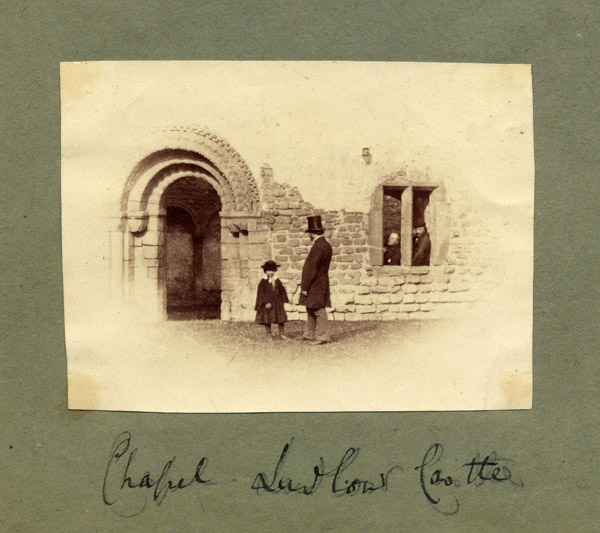
The photograph conveys a feeling of intimacy shared by a group of friends on a country outing, the conviviality of an afternoon spent exploring and photographing the ruins of Ludlow Castle where Milton wrote and performed a masque for the feast of Michaelmas in 1634. The three men and the one child in the picture can be seen relaxing as the sun declines, their spirits elevated by the charm of local larks. Moved by the intensity of ancestral moment, the friends are inspired to stage Milton's play for the camera and for audiences invisible. It is the last picture of the day.
Six year old Katherine Diamond is a little anxious about the idea, but is made to stand in the part of the virginal heroine who was abducted by the monster Comus. She leans away from the strange man standing next to her and into the direction of her father behind the camera, Dr. Hugh Welch Diamond, who has just shouted out "READY NOW!....HOLD!" Katherine is wearing a hat she cherishes, a silk ribboned Paris import which her father brought from London when her grandfather died. That was more than a year ago in October 1855. She is feeling less smart in it today, though, and more displaced by the cold and the effects of yesterday's 40 mile journey away from her house in Henley. What Katherine wants most is to get back to Feather's Inn in Ludlow Village where she can be alone with her father, but it seems like he is never alone.
Next to her, the photographer Henry Peach Robinson is playing the role of the powerful and lecherous Comus, but he, too, is a little unsure about his part. Although Robinson is fast becoming known for his abilities as a photographer of children, for his "way" with children, the little girl before him is the daughter of his mentor, the man who taught him the technique of collodion photography and who motivated him to give up a career in painting to become a photographer. It has been a good day for him though, a good week. He lives in Ludlow village nearby, but for more than a year he has been frequenting with Dr. Diamond and his wife at Surrey asylum in the Wandsworth section of London, practicing his craft and assisting him in the photographing of the "lunatics." His companions needled him into the part of Comus, pointing out that Milton's publisher was Humphrey Robinson. "He must be your ancestor, Peach!" they say, and by implication, who better to play the part of ironic villainy than the youngest and gentlest lark in their group? Their first stop from London was Leamington where they looked at a shop he had in mind for a photographic business and the good doctor promised some material support to help get him started. It is Robinson's idea to turn his back to the camera to give the picture its art of spontaneity.
The heros in Milton's play, the two brothers who journey through the perilous forest to rescue their sister from depravity and bestiality in the form of Comus, are peering out from the windows of the Round Chapel. The figure on the left is John Doran, a doctor of letters, and he is transported by the thought that Milton was once scribbling away in a room upstairs. He regrets the timbers are long gone, it would have been memorable to read his copy of the masque upstairs where Milton wrote, but it has been a week of rapturous moments for him, camping out in Arden forest and visiting the haunts of Shakespeare while his photographer friends took pictures. Doran has never been happier and he is glad he let Hugh Welch convince him to leave London for this adventure, serving them as their guide as they boistered their way through dense thickets of old verse to get to primeval Albion. So preoccupied by Milton is Dr. Doran, that he forgets the vanity of removing his reading glasses for the picture taking.
The figure to the right of John Doran is another friend of Diamond's, the quiet and ethereal Frederick Scott Archer, inventor of the wet collodion process which made this snapshot possible. He tips his hat so that enough light can fall on his face for a sun picture, but it was his friend behind the camera who reminded him to do this. Archer hopes that the photographs he took will scare up some money back in London because he is strapped. Doran promised to provide connections with publishers who might need accurate engravings of Shakespeare country or even an expensive photo book like the gem Henry Peach showed this morning, a personal copy of Shakespeare's works that Robinson illustrated with original photographs and bound in oak panels that he carved from the Herne oak. The famous photographer hasn't told his companions, but he is losing his health and he can feel, physically, the shadows reclaiming the vigors of the Leamington mineral waters that he had hoped would effect a cure.