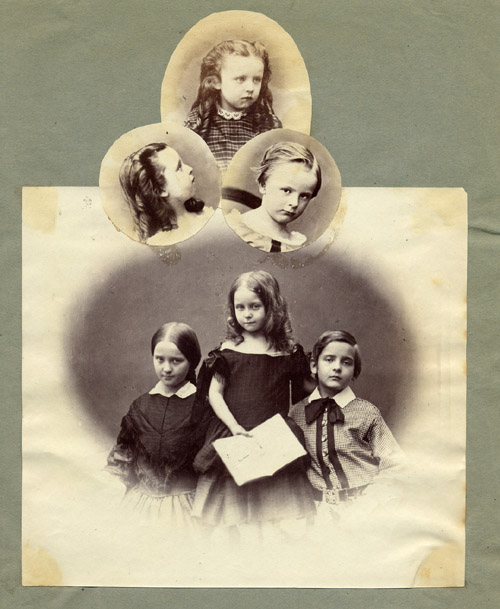
On the back of a beautiful photographic study of siblings appears the notation, "Children of Lord Leigh." According to the book, Peerage of the British Empire this would be William Henry Leigh (1824 - post 1890), and the names of the first three children born to him were:
|
The house of Leigh is seated in Stoneleigh about a mile south of Coventry and about 3 miles north of Leamington where H. P. Robinson established his first studio. Leigh's father, the first lord baron Chandos Leigh, was a friend of Lord Byron, competitive with Byron in the writing of poetry, but not as well known. To my eye the youngest child in the photograph, Agnes-Eleanor, appears to be a proud 5 year-old which would date the photograph about the middle of 1858. The National Portrait Gallery lists a photograph by Silvy of three Lord Leigh children dated 1860, but unfortunately there is no thumbnail, so for the purpose of this paper it will be assumed that Robinson is the creator of the negative for the print shown here. This notion is supported by the compositional element of the open blank book held by Agnes Leigh – a highly charged and purposeful reference to Locke which may be why Lord Leigh turned to Silvy for subsequent photographs of his children. What appears to be an autograph or epigram on the page of the book is more likely surface abrasion from a tiny piece of graphite or a grain of coal dragged a few millimeters across the surface. A high resolution 1600 dpi scan of the prop was unproductive and a microscope is needed to resolve this question.
Regarding the sweet portraits mounted above the photo, it is unlikely that they represent younger versions of the children below. The left and top cameos look like two perspectives of the same child and may even be early 1860's images of Robinson's daughter, a notion that comes from a comparison with plate 73 of Harker. This would suggest that the cameos are an experiment or screw-up by Robinson. The cameos could also have been added by the teen responsible for the other paste-ups, but if true, it was not in character – all of the other damage was done with graphics cut from magazines. Were they added by Hugh Welch Diamond, playing around with the glue pot technique of his friend? This theory is not so far fetched if the inscription proves to be in Diamond's handwriting. It is difficult to see the writing, however, and will require cutting open the back of the mount for closer examination. Furthermore, one other photographic composite that might be attributable to Diamond shows up in this set of album pages.